
Buying office furniture for a company is not like buying a chair for yourself. Between the first quote and the final signature there are usually six or seven documents, several people who need to approve them, and an accountant who will ask, quite reasonably, where the e-invoice is. Miss one document and a payment stalls, a delivery is not accepted, or the books have a gap that someone has to explain later.
This guide walks through the paper trail for a cashless purchase of office furniture in Kazakhstan, in the order it happens: quote, contract, invoice, payment, delivery, ESF (Kazakhstan's electronic invoice) and, when installation is included, the completion act. It is written for procurement managers, office managers and accountants, and it works with any supplier, not only with us.
The short version
- Get an itemised commercial offer you can compare line by line.
- Sign a contract with the specification attached.
- Pay against the invoice, quoting the contract number.
- Receive the goods with a power of attorney and check them before you sign.
- Make sure the ESF arrives, and that it matches the contract and the delivery note.
- If the supplier also installs, sign a completion act after you have inspected the work.
Six documents for a company furniture purchase in Kazakhstan: commercial offer, contract, invoice, delivery note, electronic invoice (ESF) and completion act The six documents in a cashless furniture purchase, in the order they appear.
The document trail at a glance
Each document answers a different question. Knowing which question it answers tells you what to check before you sign it.
| Document | Who issues it | What it does | Check before you sign |
|---|---|---|---|
| Commercial offer | Supplier | Describes what you will get, for how much, and for how long the offer is valid | Models, sizes, finishes, quantities, currency, VAT, validity period |
| Contract and specification | Both parties | Turns the offer into binding terms | Payment schedule, delivery terms, acceptance procedure, warranty, penalties |
| Invoice for payment | Supplier | Tells your bank what to pay and to whom | Bank details, amount, contract reference in the payment purpose |
| Power of attorney | Your company | Authorises a named person to receive the goods | Name, ID details, list of goods, validity dates |
| Delivery note | Supplier | Records what was handed over, and when | Quantity, model, finish, visible damage |
| Electronic invoice (ESF) | Supplier, in the state IS ESF system | The tax document for the sale | Amount, VAT, date, match with contract and delivery note |
| Completion act | Supplier, signed by both | Confirms that installation or other services were completed | Scope matches the contract, work inspected |
Step 1. Get an offer you can actually compare
A good commercial offer lets someone who was not in the room understand exactly what is being bought. If you are collecting offers from several suppliers, as most procurement policies require, the only way to compare them fairly is to make them describe the same thing.
Ask every supplier to include:
- The exact model and variant of every item. "Executive chair" is not a specification. A chair with a size, a frame colour, a base and a type of armrest is.
- Quantities and unit prices, so you can see where the total comes from.
- The currency and whether the prices include VAT.
- The validity period of the offer.
- What is included: delivery, unloading, assembly, installation, removal of packaging.
- The warranty, and who handles a claim if something goes wrong.
If you are not yet sure what to specify, start with a design brief. It is much easier to compare offers when every supplier answers the same brief. For premium brands, also check the supplier's authorisation: our guide to verifying a genuine Herman Miller chair explains what an official dealer can show you.
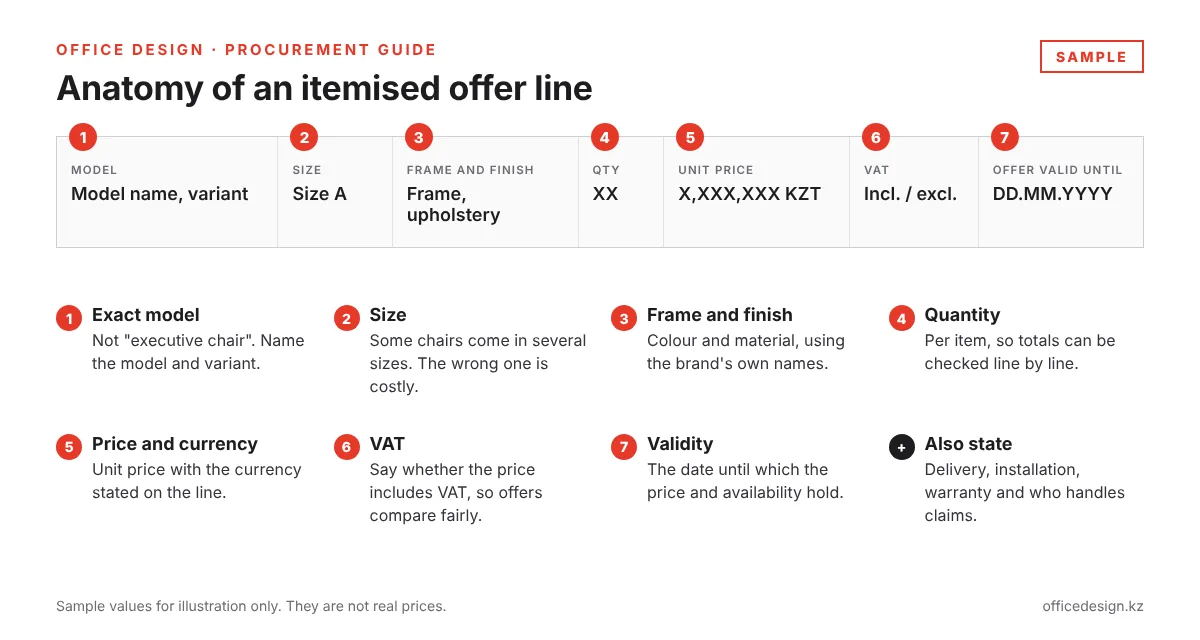
What an itemised offer line should show. Sample values for illustration only.
Step 2. Put it in a contract
Under Article 152 of the Civil Code of Kazakhstan, transactions made in the course of business must be in simple written form, except those that are performed at the moment they are made, such as paying and taking an item over the counter. A supply of furniture that will be delivered later is not one of those exceptions. Written form can also be met by exchanging signed documents, but a single contract with a specification attached is much clearer, and if there is ever a dispute about quality, quantity or delivery dates, documents are far easier to rely on than recollections.
For a furniture purchase, the contract and its specification should cover:
- The specification as an annex. Every item, model, size, finish and quantity from the accepted offer. Details matter: an Aeron comes in three sizes, and the wrong one is a costly mistake. Our Aeron size guide shows why.
- Price, currency and VAT. If prices are fixed in a foreign currency and paid in tenge, the contract should say which exchange rate applies and on which date. This is the clause that causes the most arguments when the rate moves.
- The payment schedule. Furniture that is made to order is usually paid in stages, for example an advance on order and the balance at an agreed milestone. Whatever you agree, write it down with dates or triggers.
- Delivery terms. Address, access conditions, delivery window, who unloads, and who is responsible for the goods until they are accepted.
- The acceptance procedure. How many days you have to inspect the goods, and how defects are recorded and resolved.
- Warranty. What it covers, for how long, and whether claims go through the supplier or the manufacturer. For Herman Miller products bought from an authorised dealer, see our 12-year warranty guide.
- Penalties and force majeure for late delivery or non-payment.
- Installation scope, if the supplier installs. Which floors, which rooms, what is the sequence, and who prepares the site.
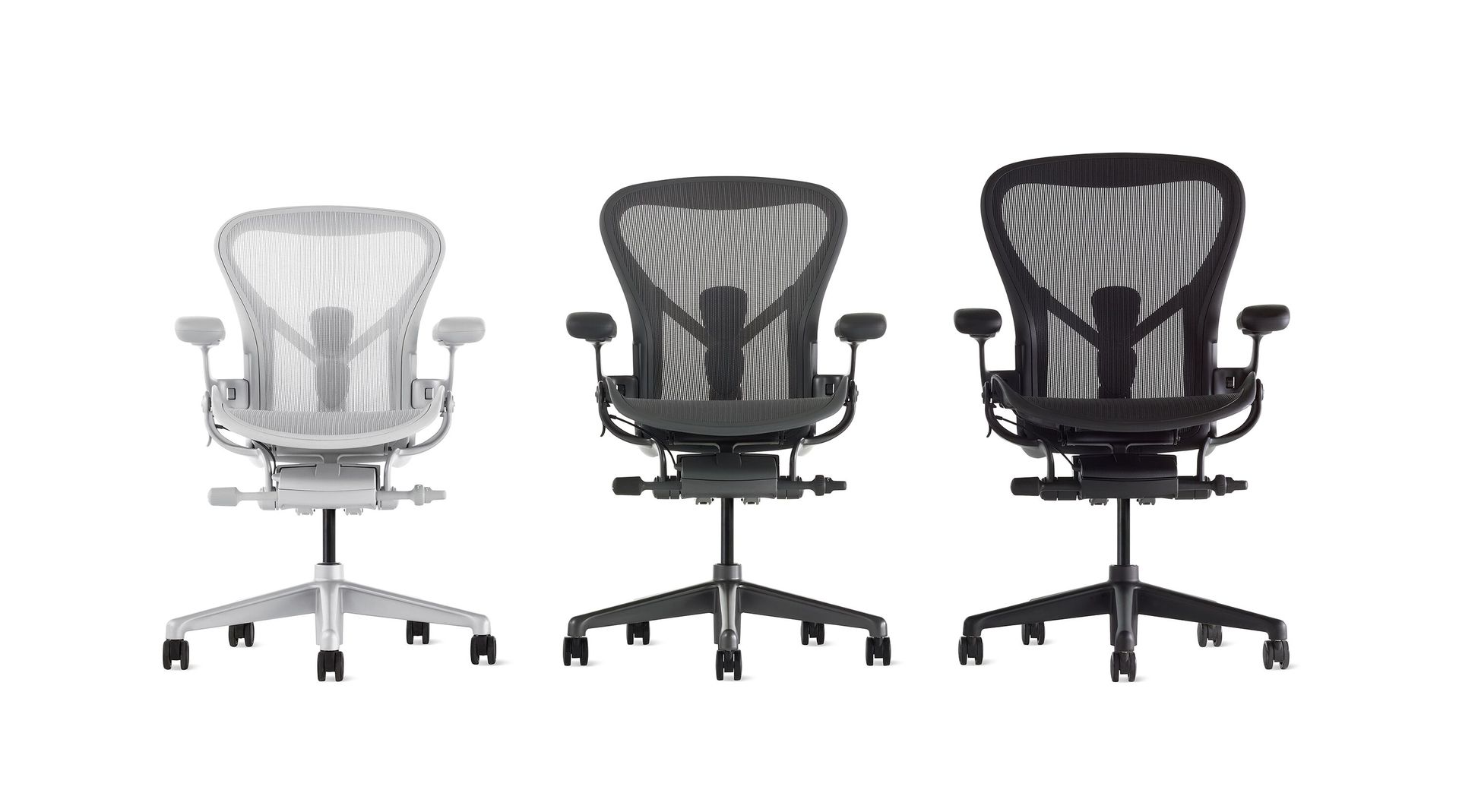
Aeron comes in three sizes, so the specification must say which.
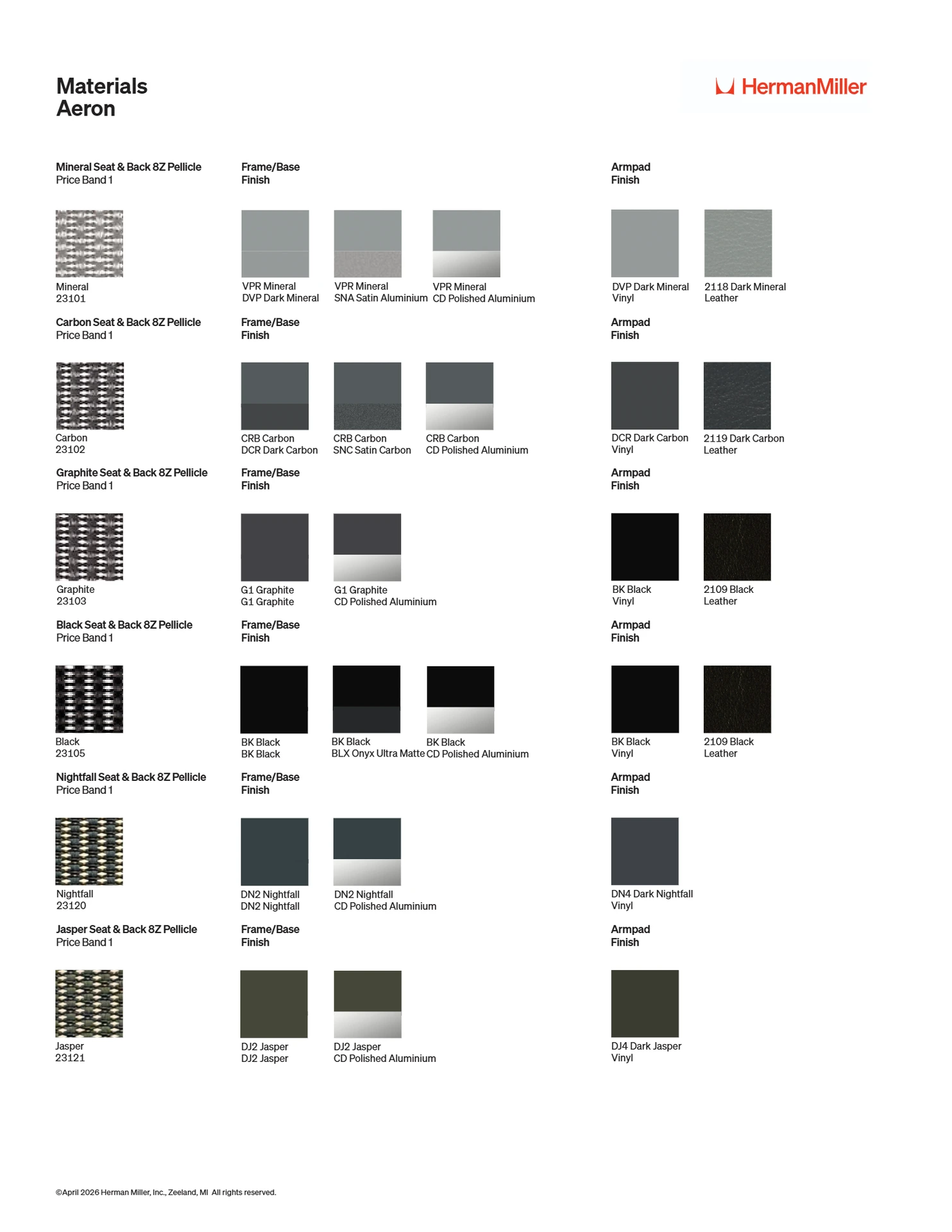
Finish and colour options are part of the specification, not an afterthought.
If the order is part of a bigger fit-out, align the contract with the project plan. Our step-by-step fit-out guide shows where furniture delivery sits in the timeline.
Step 3. Pay against the invoice
The invoice for payment is what your accountant uses to make the transfer. It is not the tax document: that is the ESF, covered below.
Before the payment goes out, check three things:
- The bank details match the supplier named in the contract. Fraudulent invoices with altered details exist, so be cautious about details that arrive by email without any prior contact.
- The amount matches the payment schedule in the contract, not just the total.
- The payment purpose refers to the contract number and date. This is what lets both accountants match the payment to the right deal.
A note on VAT in 2026
The standard VAT rate in Kazakhstan has been 16% since 1 January 2026 (it was 12% before). VAT is calculated at the rate in force on the date of the supply, so if an offer was prepared last year, or a delivery straddles the new year, ask the supplier to confirm which rate applies. Also confirm whether your supplier is a VAT payer, and whether the prices in the offer include VAT, before you compare totals.
Step 4. Receive the goods properly
The person who receives the delivery needs authority to do so. Unless it is the director, that means a power of attorney issued by your company, naming the person and describing what they may receive. Prepare it before the delivery date, not on the loading dock.
At delivery:
- Count the packages against the delivery note before the truck leaves.
- Check model, size and finish against the specification, not just the quantity. Open at least a sample of the boxes.
- Note visible damage on the delivery note itself before you sign, and take photographs.
- Keep a signed copy.
Signing the delivery note usually means you have accepted the goods as delivered. If you have not been able to inspect everything, say so on the document and agree the inspection period in writing.
Step 5. Make sure the ESF arrives
The ESF is the electronic tax invoice for the sale. The supplier issues it in the state information system IS ESF and signs it with a digital signature (EDS). Your accountant will see it in their own IS ESF account and will want to match it to the contract, the invoice and the delivery note.
Two practical points:
- Timing. For an ordinary sale of goods, the ESF is issued from the date of the supply and no later than 15 calendar days after it. If your goods are delivered on 5 October, the deadline is 20 October. Put a reminder in your calendar and ask your supplier early if it has not appeared.
- Who issues it. Under the Tax Code in force since 1 January 2026, ESF is issued by VAT payers and, in specified cases, by some other taxpayers too. If you are buying from a supplier that is not a VAT payer, ask how the sale will be documented.
If the numbers on the ESF do not match the contract or the delivery note, raise it immediately. Corrections are far easier to arrange in the same month than a year later at audit.
Step 6. Close out installation with an act
If the supplier also assembles or installs the furniture, that is a service, and it is normally closed with a completion act. Do not sign it until you have walked the space: check that everything in the specification is in the right place, that chairs and desks are adjusted and working, and that packaging has been removed. Defects found at this point are the supplier's to fix. Defects found after you have signed are an argument.
The most common mistakes
- Paying against a quote with no contract. You have no agreed delivery date, no agreed remedy, and no clear record of what was ordered.
- A specification without sizes and finishes. The supplier delivers what the document says. If the document is vague, so is your remedy.
- No currency clause. A price that was fair at signing can look very different at the date of payment.
- Signing the delivery note without inspecting. It is the strongest evidence in any later dispute, so treat it that way.
- Forgetting the ESF. It is easy to lose track of once the furniture is in the building. Your accountant will not forget.
- Leaving warranty claims unassigned. Decide in the contract who your contact is when something fails in year two.
Ask for the document pack early
Procurement teams save weeks when they ask for supporting documents at the start, not at the end. A supplier should be able to give you, on request:
- The company's registration and bank details
- Proof of authorisation from the manufacturer, where the products are branded (a dealer certificate or letter)
- A draft contract and specification template
- The warranty terms in writing
- References from comparable projects
If a supplier cannot produce these before you order, that tells you something about how the rest of the process will go. When you are choosing between partners for a larger project, our 15 questions to ask an office fit-out partner is a useful companion to this guide.
Frequently asked questions
Do we need a contract for a small order?
In practice, yes. Business transactions need written form unless they are performed on the spot, and a delivery that happens later is not. For a small order a short contract with a one-page specification is enough. Keep it together with the accepted offer, the invoice and the signed delivery note.
Is the invoice for payment the same as the ESF?
No. The invoice for payment is a request for payment. The ESF is the tax document that records the sale itself, issued after the supply in the IS ESF system.
When should the ESF arrive?
For an ordinary supply of goods, within 15 calendar days of the date of the supply. Check with your accountant for any special cases.
What VAT rate applies?
The standard rate has been 16% since 1 January 2026. The rate depends on the date of the supply and on the supplier's VAT status, so confirm both in writing.
Can we compare offers from three suppliers?
Yes, and many internal procurement policies require it. Give each supplier the same brief and ask for the same elements in the offer (model, size, finish, quantity, currency, VAT, validity, inclusions), so the comparison is like for like.
Planning a purchase for your company?
Send us your list or your brief, and our team will prepare a commercial offer that is itemised and ready for your procurement process. If you would like to see products first, we can arrange a visit to the showroom.
Request a commercial offer
This guide is general information based on rules in force in October 2026 and is not legal or tax advice. Confirm the details for your own transaction with your accountant or lawyer.