
The short answer
Office furniture delivery cost in Kazakhstan is driven by the shipment volume and weight, route, packing, handling, building access, unloading and the work required after arrival. For a reliable comparison, price the complete handover at the destination, then check what the carrier and furniture supplier each include.
Key takeaways
- Ask whether the carrier prices by actual weight, dimensional volume, pallet space or a minimum consignment charge.
- Record packed dimensions, lift limits, loading access and the exact destination point before requesting quotes.
- Separate freight, unloading, assembly, installation and AV commissioning in the cost sheet.
- Compare the schedule against the full furniture procurement timeline, including the Europe ordering allowance where relevant.
- Confirm insurance, damage reporting and responsibility at every handover.
In this article
- How is office furniture delivery cost calculated?
- Which cargo details change the quote?
- How do packaging and handling affect the total?
- Which delivery option fits an Almaty to Astana workplace project?
- How should IT and AV teams plan access and installation?
- How do price, schedule, warranty, ergonomics and productivity compare?
- What timing should a Kazakhstan office project plan around?
- What hidden charges belong in the budget?
- How can procurement compare transport quotes fairly?
- What should you do next?
A company may be preparing a second office in Astana while its main workplace team sits in Almaty. The furniture list looks familiar: desks, task chairs, storage, a meeting table and a room for video calls. The delivery estimate, however, can change once dimensions, access and installation are added.
For office furniture delivery in Kazakhstan, ask for one scope across every quotation. The office furniture transport brief should state whether the carrier uses volume-based freight, actual weight or a minimum charge. For intercity furniture delivery, confirm the route and the final handover point. Keep office furniture installation as a separate line until the responsible team confirms it.
The IT and AV lead also has questions that a simple freight price will not answer. Will the display fit through the service lift? Can the table arrive before the floor boxes are covered? Who connects the room equipment after the furniture is assembled?
This guide gives procurement, facilities and technical teams a way to compare options using the same scope. It explains how carriers may rate a consignment, what makes bulky items harder to handle and how to avoid treating transport as a separate task from the office handover. For the wider workplace scope, see Office Design services for workplace planning and furnishing.
How is office furniture delivery cost calculated?
A quote starts with transport from the current location to the agreed destination. The carrier may price by minimum charge, actual weight, volume or chargeable space. Handling and optional services can add to the total.
Build the total before comparing quotes
|
Cost element |
What it covers |
What to confirm |
|
Base transport |
Movement between origin and destination |
Route, mode, rate basis and minimum charge |
|
Collection and loading |
Pickup, loading labour and vehicle access |
Who prepares and loads the goods |
|
Packing and protection |
Wrapping, crates, corner protection and restraints |
Whether packing is included and who supplies it |
|
Destination handling |
Unloading, carrying, lift use and floor delivery |
Exact handover point and access limits |
|
Assembly and installation |
Furniture assembly, placement and fixing |
Which items need assembly and who is responsible |
|
Technical work |
Screens, power, data, cable management and testing |
Whether AV work is a separate contractor scope |
|
Risk and contingencies |
Insurance, storage, redelivery or waiting time |
Cover limits, exclusions and delay charges |
A published Kazakhstan carrier calculator illustrates the variables that can sit behind a freight estimate. It asks for a route, shipment type, weight or volume and optional services. It also distinguishes delivery to an address from delivery to the destination using a vehicle class. Treat this as an example of quote structure, not a price reference for your project. See the ABKTRANS freight calculator.
Use the same list for every supplier response. A quote that includes vehicle transport to a building entrance is not directly comparable with one that includes carrying to the floor, unpacking and removal of packaging. Record each service as included, excluded or awaiting confirmation.
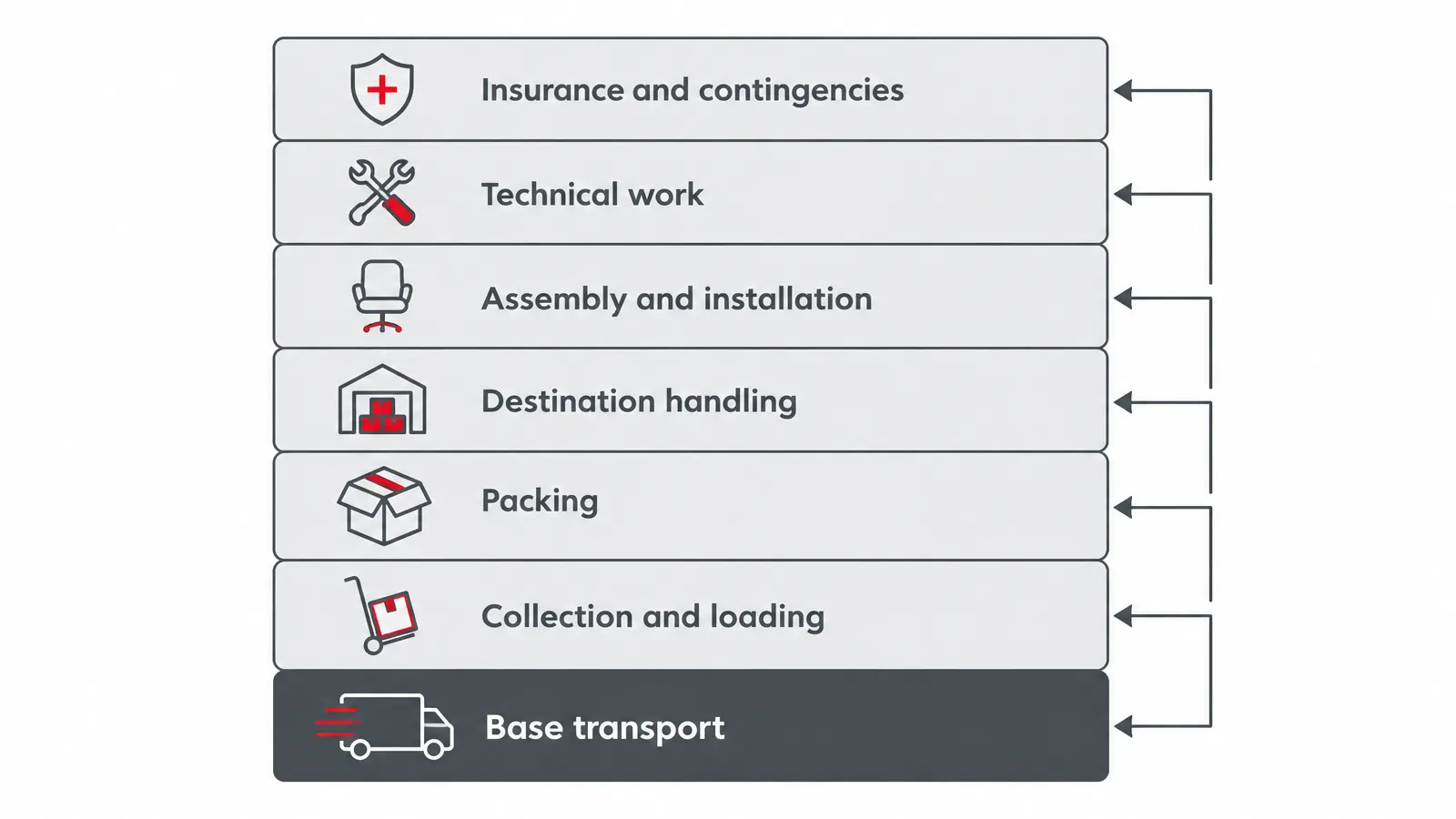
Compare each service as a separate line before treating two freight quotations as equivalent.
Which cargo details change the quote?
The carrier needs a physical description of the shipment. List the item count, actual weight, packed volume, dimensions and whether items can be stacked. Note any special handling needs. One oversized item can affect the vehicle and price, even when the other cartons are standard.
Create a line-by-line schedule from the furniture list. For each item, record the maker or model, quantity, unit dimensions, gross weight, packed dimensions, packed weight and package count. Use the office chair category to identify the product family. The carrier still needs exact packed data for each model. If those measurements are missing, mark them as pending. Do not use product dimensions as shipping dimensions.
Furniture is often light compared with machinery, but it can occupy substantial space. A carrier may calculate a bulky item by its volume because it uses a large part of the vehicle. The reverse can also occur: compact equipment with a high gross weight can hit a weight limit before the truck is full.
Cargo record for the quote request
|
Field |
Example entry |
Why it matters |
|
Item description |
24 workstation sets |
Shows the shipment mix |
|
Quantity and packages |
24 desks, 24 chairs, 48 cartons |
Clarifies handling units |
|
Product dimensions |
Supplier specification |
Useful for planning only |
|
Packed dimensions |
Confirmed crate or carton size |
Supports chargeable-volume calculation |
|
Gross weight |
Supplier or packer figure |
Supports weight limits and loading |
|
Handling class |
Fragile, upright, non-stackable |
Changes restraint and handling plan |
|
Value and cover |
Declared value with agreed policy |
Supports insurance discussions |
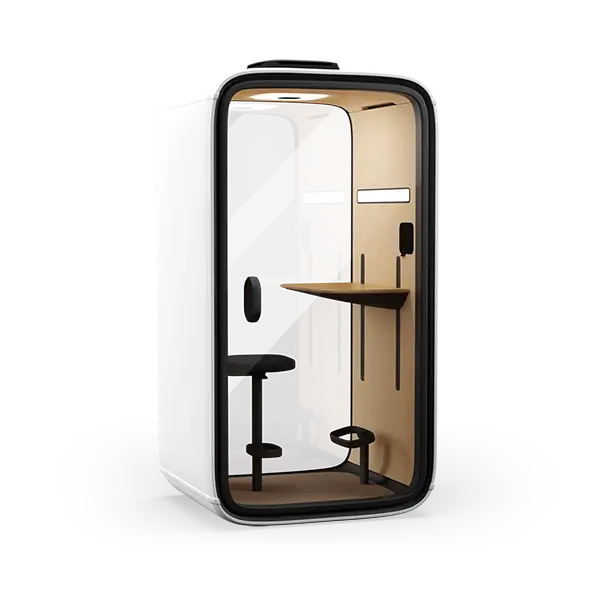
For a technical room, ask for the dimensions of the screen, rack, equipment case and any table with integrated cable access. Where the scope includes a broader workplace layout, review the Office Design solutions by space as a reference for the room types being planned. A screen carton may have a different orientation requirement from a desk carton. A rack may be compact but heavy. A booth or pod can require a separate handling plan.
Framery lists a product weight of 357 kg and external dimensions of 225.5 × 122 × 100 cm for Framery One. These are product figures, not packed dimensions. Confirm the packaging and exact configuration before requesting a quote. Record a powered enclosure separately from desks and chairs. See the Framery One technical specifications.
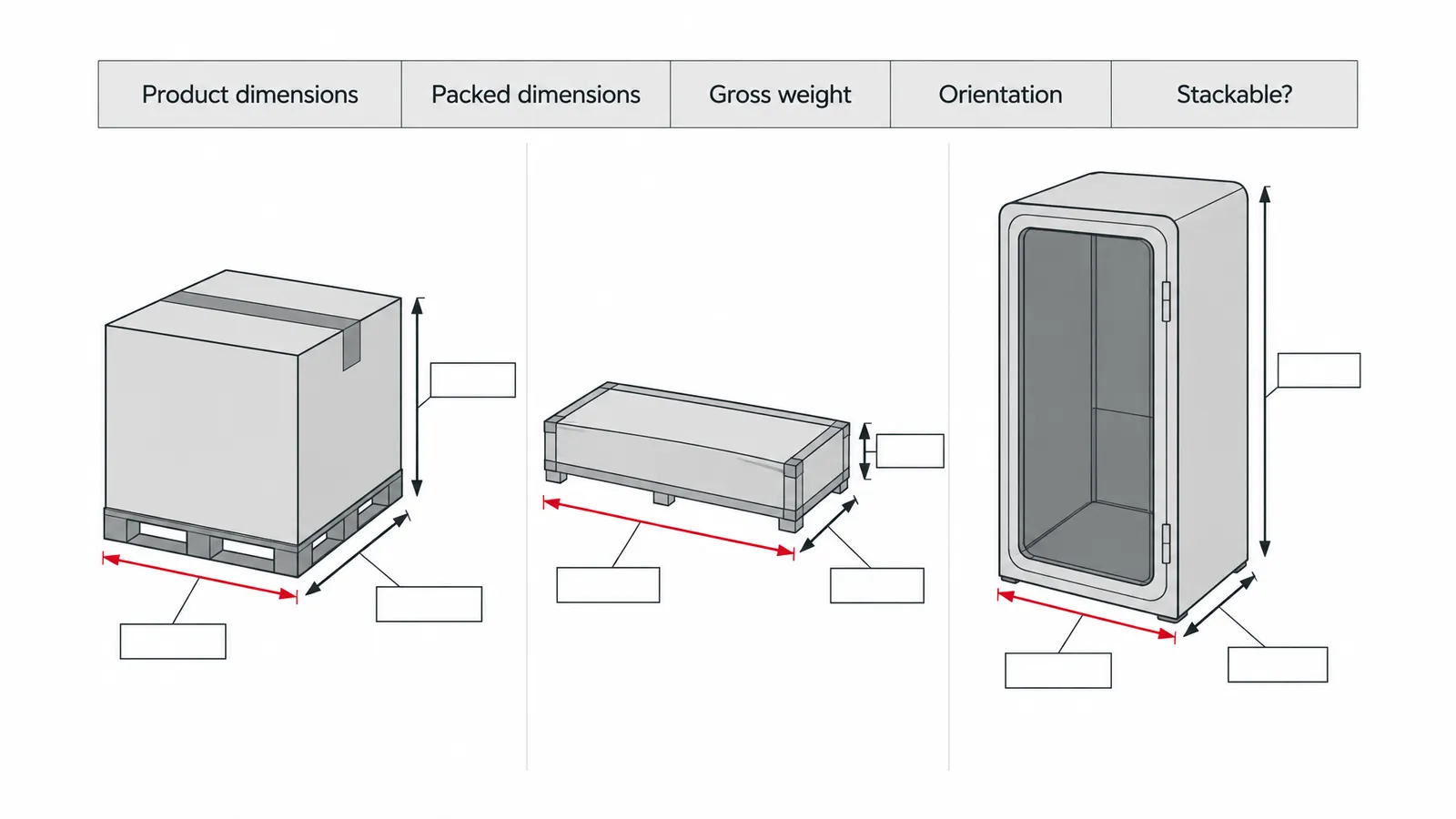
Carrier pricing should use confirmed package data, not the furniture dimensions alone.
How do packaging and handling affect the total?
Packing affects the quote because it changes the shipment dimensions, protection level and time required to load or unload. Handling requirements can also limit stacking, vehicle choice and access. Procurement should ask who packs each item, who checks it at collection and who records its condition at delivery.
A flat-packed desk may travel in several labelled cartons. A pre-assembled table can need a long, protected package. A glass panel may require edge protection and a fixed orientation. An acoustic pod may arrive in large sections with manufacturer instructions for lifting and assembly. Each format uses a different amount of space and labour.
Request packing information before the carrier prices the job. Ask for a packing specification with the package count, dimensions, gross weight, lifting points, orientation marks and any requirement to keep a component upright. If the furniture supplier plans to pack the goods, state whether the carrier collects them already packed or is expected to provide packing as a separate service.
The loading bay rarely reads the project programme.
A carton marked “fragile” still needs a handling plan.
A corridor turn is a measurement, not a footnote.
- Confirm whether the quote includes packing materials and labour.
- Ask who is responsible for damage caused by unsuitable packing or incorrect handling instructions.
- Photograph the condition and package count at collection and again at destination.
- Record visible damage on the handover document before signing, following the carrier’s claim process.
- Keep assembly instructions and hardware packs matched to the relevant furniture item.
For fragile or high-value items, ask the carrier to describe the restraint and handling method. The response should explain how the item will be secured, whether it can be stacked and who is permitted to move it after unloading. A vague promise to take care of the goods is difficult to use when a claim is raised.
The government portal publishes Kazakhstan transport-law materials on cargo carriage and delivery. Record the agreed terms, responsibilities and delivery evidence in the contract or transport document. Ask legal counsel to check the rules that apply to the shipment. See the government transport-law reference.
Which delivery option fits an Almaty to Astana workplace project?
The right option depends on the shipment and the destination building. For a hypothetical Almaty to Astana fit-out, compare a single road load, rail with road legs, or staged deliveries linked to installation. Each option has a different number of handovers and access checks.
One shipment can make stock control easier and cut handovers. The site must be ready to receive all goods at once. It also needs enough storage. Staged deliveries can reduce floor congestion. They may add more visits, handling and storage charges.
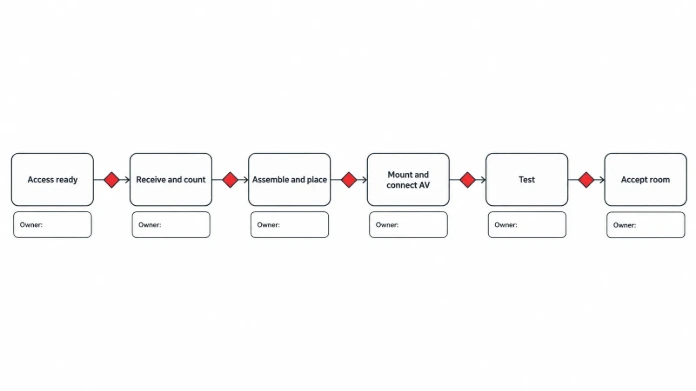
Plan the arrival around room readiness and the technical sign-off.
Options to assess for a city-to-city move
|
Option |
Can suit |
Questions to price |
|
Consolidated road movement |
A planned delivery with enough volume for a dedicated or grouped load |
Vehicle size, route, access, transit estimate, unloading and waiting time |
|
Rail movement with road legs |
A shipment where the rail option is suitable and first or last mile can be managed |
Terminal handling, packaging, transfer points, storage and final delivery |
|
Staged deliveries |
A phased fit-out with limited storage or room-by-room handover |
Number of visits, holding space, redelivery, sequencing and inventory control |
|
Special handling movement |
Oversized, fragile or heavy pieces needing a defined lift or restraint plan |
Equipment, crew, access, permits where required and responsibility |
Do not choose from the transport line alone. Compare the whole route from the collection point to the correct floor or room. If a carrier unloads at a terminal and another party handles the final leg, the quote should show both parties, the transfer point and the moment responsibility changes.
A freight quote that says “delivery” without defining the final door is a short document with a long list of assumptions.
The lift is the one project stakeholder that never accepts a calendar invitation.
The Office Design projects overview can help a reader understand the type of workplace settings the company presents. It does not establish that a particular carrier, city route or installation service is available for a new enquiry. Confirm the scope for the named building and city before including it in a procurement plan.
Illustrative project scenario
Assume an Almaty team is fitting out a second office in Astana. The list contains 24 desks, 24 chairs, storage, one meeting table, two displays and one acoustic pod. The team asks each carrier to price the same package list, the same destination point and the same unloading scope. No rate is assumed here. The comparison is useful only after packed dimensions and all service boundaries are confirmed.
How should IT and AV teams plan access and installation?
IT and AV teams should check the route into the building and the technical sequence before the furniture leaves the origin. Screen sizes, rack weights, table cut-outs, power points, data outlets and cable routes affect where items can be installed. A delivery can be physically complete while the room is still unusable.
Walk the destination route with facilities or the building manager. Measure the loading entrance, corridor turns, door clearances, service lift, lift capacity and floor access. Record loading-bay booking rules, delivery hours, security requirements and the distance from the unloading point to the final room. Photograph the route where possible.
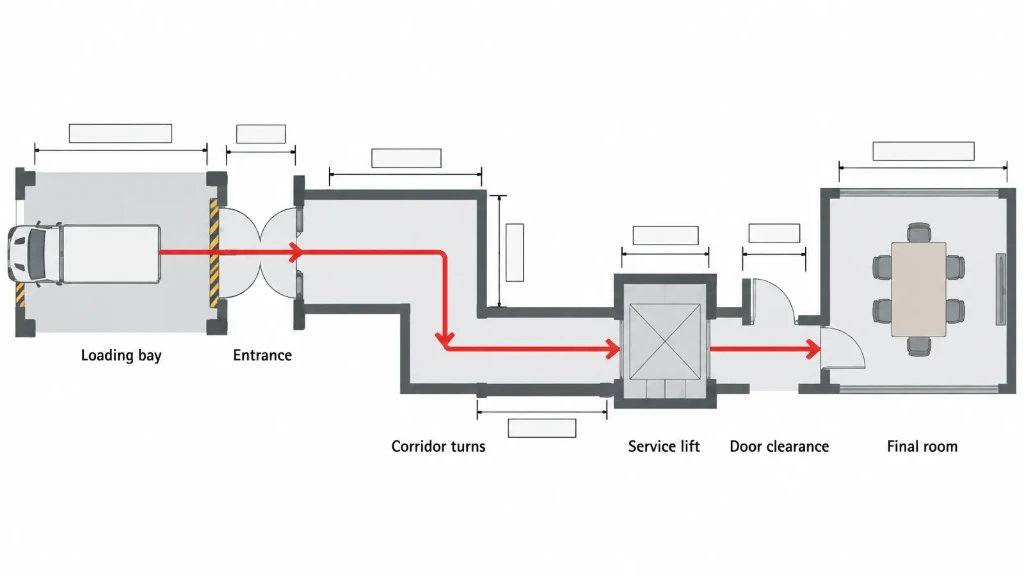
Measure the route from vehicle to room before the carrier confirms the handling scope.
Then align the furniture plan with the AV drawings. A conference table may need power and data access through a floor box. A display wall needs suitable support and a clear route for cables. A room rack needs ventilation, power and a location that does not block circulation. The team should sign off those details before installation begins.
- Name the room and exact placement for each display, rack, table and acoustic enclosure.
- Mark floor boxes, wall outlets, data points and cable routes on the latest plan.
- Confirm display dimensions, mount type, wall construction and the lifting route.
- Check whether furniture arrives assembled, partly assembled or in cartons.
- Assign the owner for furniture assembly, AV mounting, cable termination and testing.
- Set an acceptance check for power, network, audio, video and room control after installation.
The manufacturer’s planning tools matter here because the furniture plan needs to be usable by the design and technical teams. The Living Office workplace framework is another reference for connecting work settings with the furniture plan. Herman Miller provides planning ideas and downloadable plan resources in formats such as Revit, SketchUp and AutoCAD. Use the relevant drawing as a coordination input, then reconcile it with the actual site survey and the approved AV design. See Herman Miller planning ideas and tools.
A screen that arrives after the table is fixed can reveal a blocked cable route. Set the sequence before delivery. Protect the access route first. Place large furniture next. Mount AV when the support and power are ready. Then connect and test the room.
How do price, schedule, warranty, ergonomics and productivity compare?
A delivery decision should be reviewed alongside the furniture decision. Procurement needs the full purchase and operating cost, the project schedule, written warranty terms, employee fit and the work the space must support. A low transport quote can still leave the organisation with extra handling, a late room or unclear responsibility.
Price and total cost
Keep the purchase price and transport as separate lines. Then calculate the cost of getting each item into use. Include packing, handling, unloading, storage, assembly, installation, packaging removal and any re-delivery. Record the documented warranty period too. Check the local terms before using it in the ownership calculation.
For products within the MillerKnoll brand range, the manufacturer’s public warranty page describes a 12-year limited warranty for many products, but its service-cost wording is specific to the United States and Canada. That page is not evidence that the same service arrangement applies in Kazakhstan. Request written product and country terms for the exact order. The Herman Miller warranty and service page should be read with that regional limitation in mind.
Schedule and delivery sequence
Compare the expected arrival date with the date each room is ready. The carrier may give a transit estimate. The building may have a fixed delivery slot. The installation team may need a separate booking. For Herman Miller office solutions for business and MillerKnoll orders from Europe, plan about 70 days for ordering and delivery from Europe; add the installation allowance confirmed by Office Design.
Keep domestic freight as a separate line in the programme. The 70-day allowance is the client-provided Europe ordering and delivery figure. It is not a transit estimate for an Almaty to Astana shipment and does not establish a local carrier’s schedule.
Warranty and damage responsibility
Ask who is responsible at each stage of the move. A product warranty, carrier liability and a separate insurance policy cover different risks. Record the claim period, evidence needed, exclusions, declared value and process for hidden damage.
A manufacturer’s warranty may not cover transport damage or local service. Keep the order confirmation and product references. Save the packing list, photographs, transport document and signed receipt. Ask for written confirmation of the warranty territory and service route in Kazakhstan.
Ergonomics and fit
A furniture standard should be checked against the people and tasks using each setting. Confirm desk height and depth, clearances, chair adjustment, monitor position and the room layout. Transport planning should preserve the product configuration selected during the workplace assessment, including the correct size, finish and accessories.
If the project team changes a product to simplify freight, it must review the effect on user fit and room dimensions. A substitution can alter seat size, desk footprint, cable access or the number of units that fit in a room. Make the decision with the workplace planner and technical lead, then record the approved revision.
Productivity and room readiness
Productivity claims should be tied to the task and the operating condition. For a meeting room, the practical test is whether participants can join a call, see the display, hear the room and use the table connections. For workstations, confirm that the furniture layout, power and network support the work planned for that team.
Use readiness checks that can be observed. Count rooms passed, open defects, missing parts, AV tests completed and workstations released for use. Do not add a percentage improvement to the business case unless the organisation has a measured baseline and a method for comparing the result.
Workplace specialist note
When I review a delivery plan, I start with the room and the handover point. The list of furniture tells me what is moving. The floor plan, access survey and AV schedule tell me whether the team can use it after it arrives. I would rather resolve a lift or cable issue on a drawing than discover it with a truck waiting outside.
Office Design Team, Workplace specialists, Office Design
Review the workplace scope before requesting transport prices
Office Design can discuss the workplace planning and furnishing scope with your team. Ask which elements can be supported for the project city, then request written confirmation of any delivery, installation or technical work before treating it as included.
What timing should a Kazakhstan office project plan around?
Build the programme backwards from the date the first team must use the office. Work from room readiness to installation, from installation to delivery, and from delivery back to packing and collection. Add approval time for drawings, finishes, samples and AV integration. Each activity needs an owner and a confirmed dependency.
For Herman Miller and MillerKnoll orders from Europe, plan about 70 days for ordering and delivery from Europe. Ask Office Design to confirm the installation allowance for the selected products and site. Domestic intercity freight requires its own carrier quotation and transit confirmation. Do not use the Europe allowance as a substitute for a local route estimate.
An IT lead should also identify the last responsible date for network, power and AV readiness. If the room cannot accept a display mount or a table connection, moving the furniture earlier may create storage and rehandling costs. Put building approvals, floor protection, lift booking and access permits into the same programme.
Set three dates in the project tracker: goods ready for collection, destination accepted for delivery and room released for use. The last date should include furniture assembly and technical testing. If a dependency slips, update the delivery sequence before a carrier is dispatched.
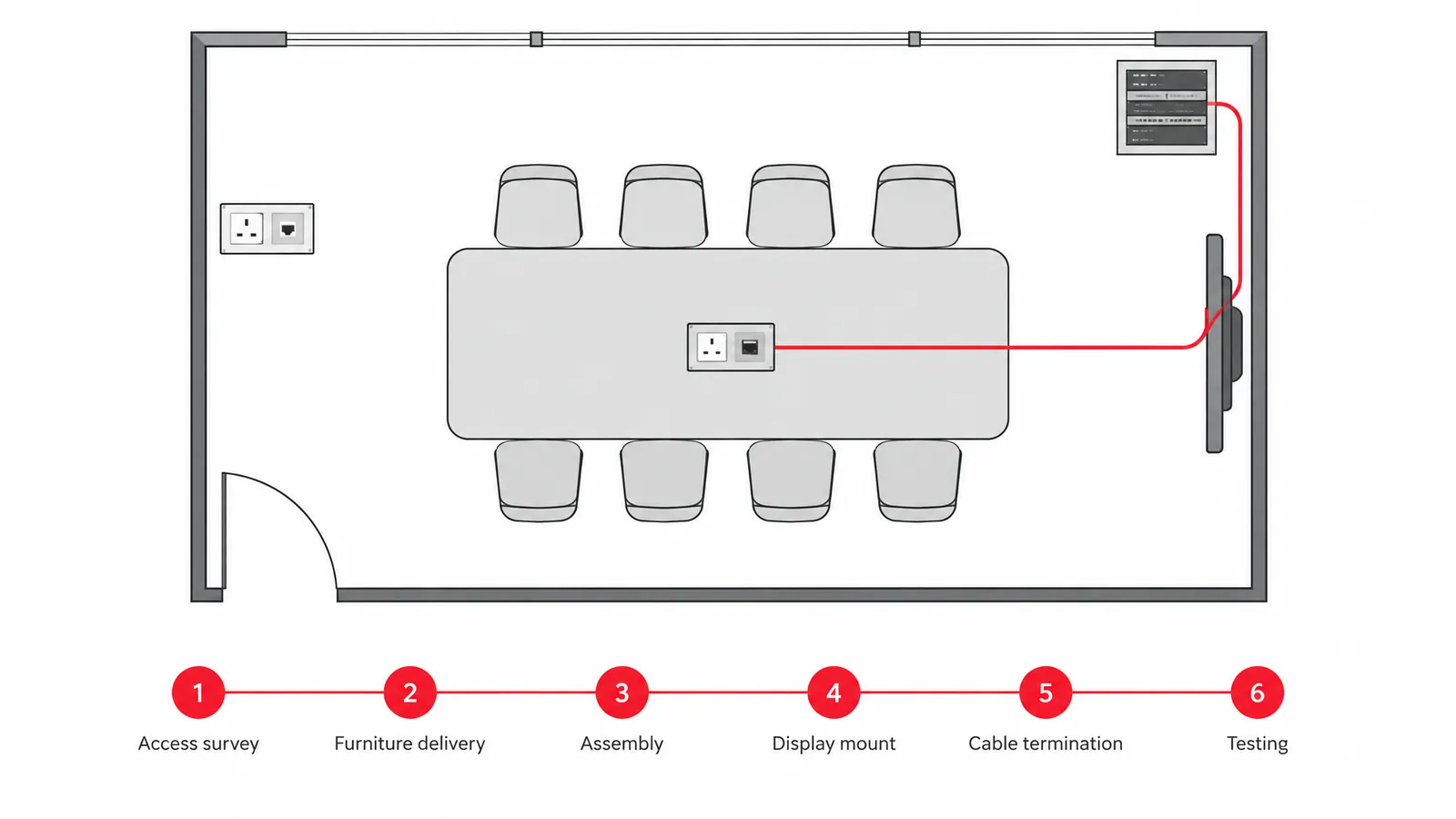
Place the delivery sequence against the final room layout and technical installation plan.
How can procurement compare transport quotes fairly?
Send every bidder the same item schedule, collection point, destination point, packing status and service requirements. Ask each to state the charging basis and list every exclusion. A fair comparison uses the same handover point and shows what happens when access, timing or package counts change.
Use the following request structure. It is short enough for a supplier email and detailed enough to make assumptions visible. Replace the sample route and quantities with the confirmed project data.
- Identify the origin address, destination address, city, building contact and required handover point.
- Attach a package schedule with quantities, packed dimensions, gross weights and handling notes.
- State the requested mode and ask the carrier to recommend alternatives if the shipment does not suit it.
- List the required services: collection, loading, insurance, unloading, floor carry, assembly, installation and packaging removal.
- Ask for the rate basis, minimum charge, exclusions, transit estimate, quote validity and payment terms.
- Ask who is responsible for damage, shortages, storage, waiting and redelivery.
- Request a revised quotation if the confirmed measurements or building access differ from the assumptions.
Compare the results in a single spreadsheet. Keep the raw quote beside the normalised scope so procurement can trace each adjustment. Mark unconfirmed services as an open item. Do not turn a supplier’s silence into an included service.
For acoustic booths and enclosed focus rooms, add the manufacturer’s installation notes to the tender pack. The Framery and Silen booth range helps identify the product family. It does not confirm delivery or installation for a specific destination. Confirm the model, configuration and scope with the project team.
For other workplace items, use the office desk range, the Herman Miller range, the Herman Miller Aeron product page and Vitra (Switzerland) furniture as product references when a precise item has been selected. These links identify product information. They do not supply packed measurements or a freight quotation.
Architects and workplace consultants can use the Office Design partnerships information when a project needs joint review. The project agreement should name the party responsible for transport and installation.
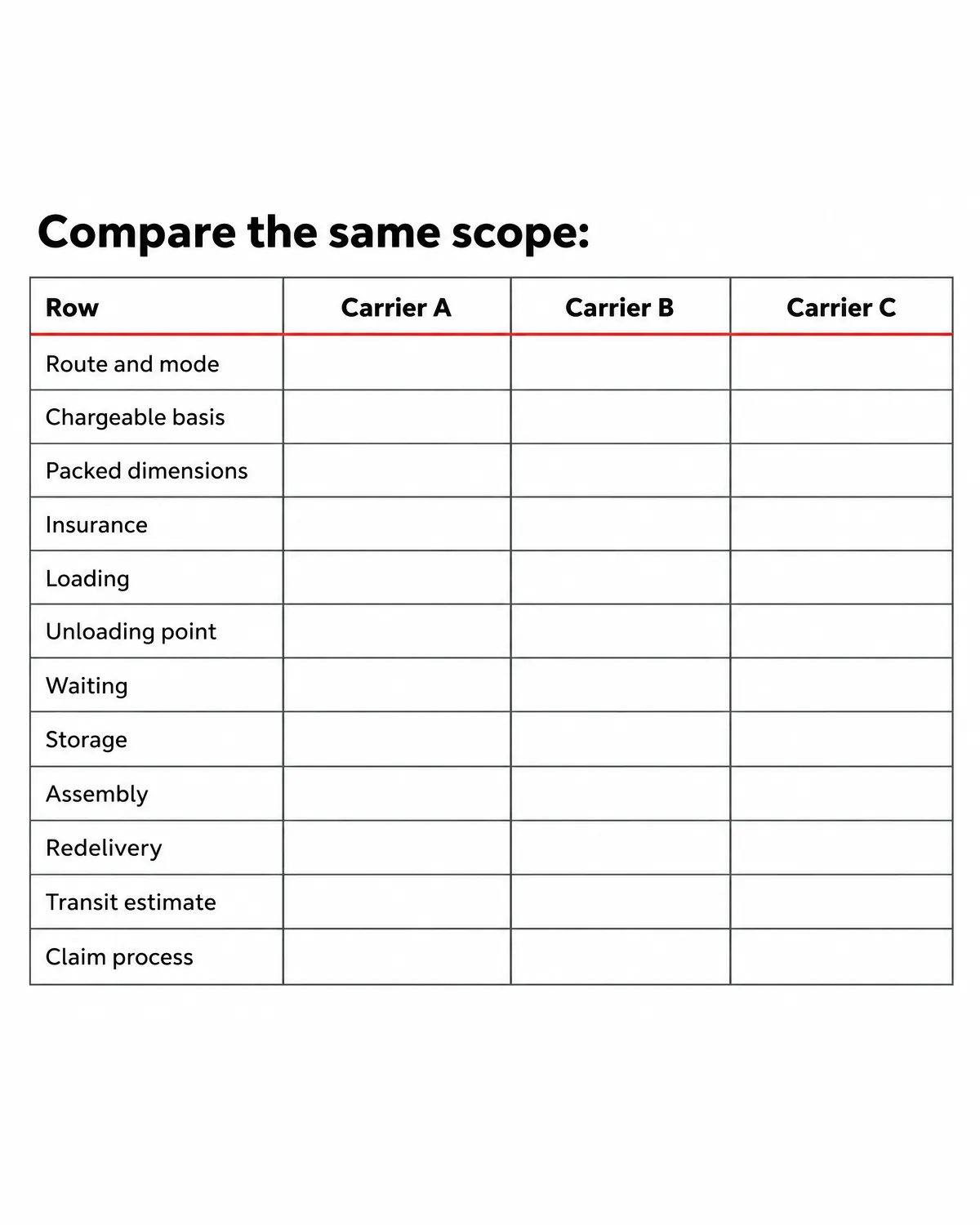
A quote comparison is meaningful only when origin, destination and handover scope match.
What should you do next?
Start with a measured shipment schedule and a destination access survey. Then ask the furniture supplier and carrier to price the same scope. Keep product procurement, domestic transport, unloading, assembly and AV commissioning visible as separate lines until each owner confirms the work in writing.
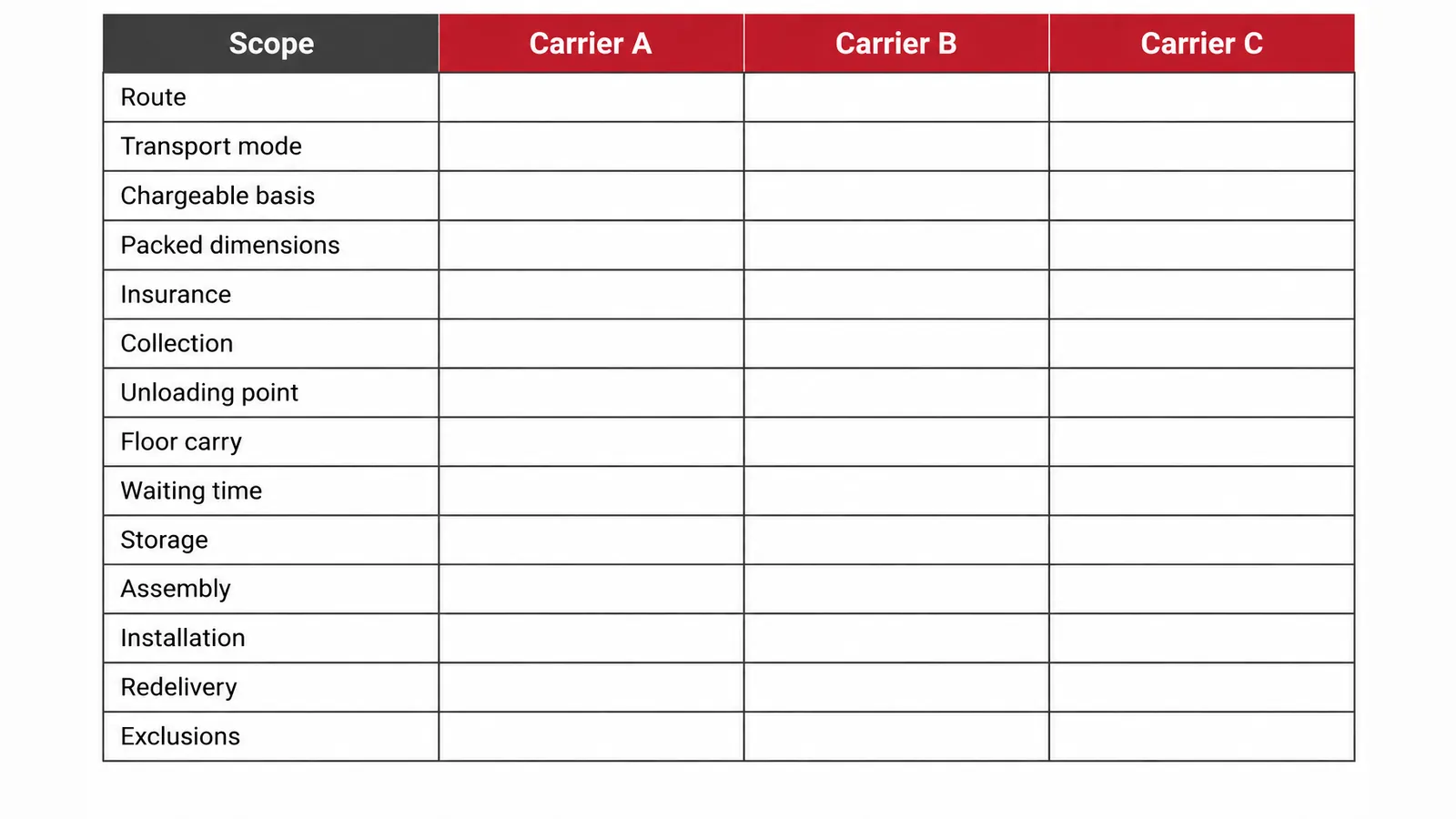
A shared scope makes freight quotations easier to compare line by line.
For an Almaty to Astana project, appoint one person to own the item register. Ask the building manager to check site access. Agree the room sequence with IT and AV. Add the Europe ordering allowance for Herman Miller or MillerKnoll orders. Ask Office Design to confirm any installation allowance.
Read the Office Design company profile for background on the business. For a project, ask which parts the team can support in the destination city. Get written confirmation before listing any route, delivery or installation service as available.
Frequently asked questions
What affects office furniture delivery cost in Kazakhstan?
The main variables are route and transport mode, chargeable weight or volume, package dimensions, packing, special handling, building access, unloading and the work included after arrival. Insurance, storage, waiting time and redelivery can also change the total. Compare the same handover point and service scope across quotations.
Is furniture transport charged by weight or volume?
It depends on the carrier, mode, route and shipment type. A carrier may use actual weight, dimensional volume, pallet space or a minimum charge. Send both packed dimensions and gross weight for each package, then ask the carrier to state the exact charging basis in the quotation.
Does the carrier price include unloading and assembly?
It may, but never assume that it does. Some quotations stop at the building entrance or loading bay. Ask separately about floor carry, unpacking, assembly, placement, packaging removal and installation. Name the final handover point in the request and have the supplier confirm each service in writing.
What should IT and AV check before furniture delivery?
Confirm the dimensions and route for displays, racks and large table components. Match floor boxes, wall power, data outlets, cable routes and screen mounts to the room plan. Assign owners for furniture assembly, AV installation and commissioning. The room should be tested before it is released for use.
Does the 70-day Europe allowance cover an Almaty to Astana freight movement?
No. The about-70-day allowance applies to ordering and delivery from Europe for Herman Miller and MillerKnoll orders, as supplied by the client. Domestic intercity freight needs its own route, mode and transit quotation from the responsible carrier.
Can Office Design confirm nationwide delivery or installation?
This article does not establish country-wide service availability. Ask Office Design about the exact project city, products and scope. Confirm in writing whether planning, transport coordination, delivery, unloading, assembly, installation and AV work are included or need separate providers.
Plan the handover before approving the freight line
Share the project location, item schedule and intended room handover date with Office Design. Ask the team to confirm the scope it can support and identify any delivery or installation services that need separate confirmation.
Office Design Team
Workplace specialists, Office Design, Office Design
Office Design specialists in Almaty plan, furnish and install corporate offices and supply Herman Miller and MillerKnoll furniture. PLACEHOLDER: replace with a named specialist and bio before the first publish (strategy: every article is reviewed by an Office Design specialist).
Read the full profile
Keep reading
Sources
- ABKTRANS: Freight calculator (accessed 2026-10-31)
- Government of Kazakhstan: Transport law and cargo carriage reference (accessed 2026-10-31)
- Herman Miller: Planning ideas and tools (accessed 2026-10-31)
- Framery: Framery One technical specifications (accessed 2026-10-31)
- Framery: Framery Six technical specifications (accessed 2026-10-31)
- Herman Miller: Warranty and service (accessed 2026-10-31)